DAMLA SANBERK
MedTech Commercial Leadership & Advisory
|
Perspectives

MDR 2026: Yerleşik teknolojiler, yeni ortaklıkların yolunu nasıl şekillendirecek?

MDR 2026: Yerleşik teknolojiler, yeni ortaklıkların yolunu nasıl şekillendirecek?

2026 yılında MDR çerçevesinde yaşanan gelişmeler, yalnızca sadeleştirme açısından değil; pazar erişimi, ürün yaşam döngüsü ve şirket yapılanmaları açısından da önemli sorular gündeme getiriyor.

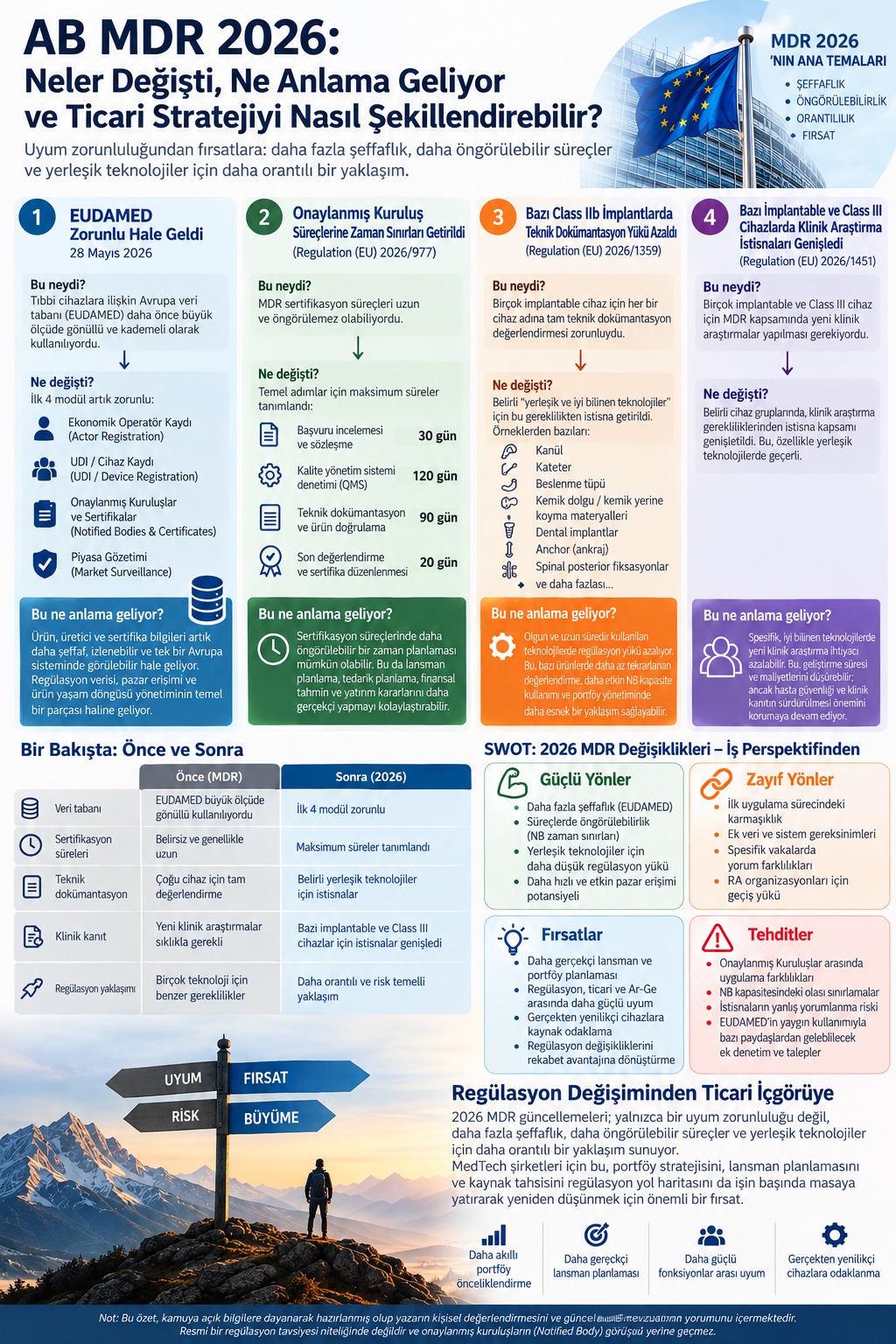
EUDAMED’in ilk dört modülünün zorunlu hale gelmesiyle daha fazla görünürlük ve izlenebilirlik artık işleyişin bir parçası haline geliyor. Bazı Onaylanmış Kuruluş süreçleri için tanımlanan azami süreler öngörülebilirliği artırmayı amaçlarken, bazı “yerleşik ve iyi bilinen teknolojiler” için teknik dokümantasyon ve klinik araştırma yükümlülüklerinde daha orantılı bir yaklaşıma geçiliyor.

Soru şu ;
Yerleşik bir teknoloji, yeni bir ortaklık, satın alma, joint venture veya teknoloji transferi yoluyla pazara çıktığında ne olur?
MDR açısından teknolojinin geçmişi tek başına belirleyici değil.

Bir birleşme veya ortaklık, yerleşik bir ürünü otomatik olarak “yeni bir cihaz” haline getirmiyor. Aynı şekilde, önceki yapının sahip olduğu regülasyon avantajlarının yeni kurumsal yapıya hiçbir değişiklik olmadan geçtiğini varsaymak da doğru değil.

Şu sorular stratejik hale geliyor:

Yasal üretici değişti mi?

Kullanım amacı aynı mı?

Teknik dokümantasyon ve klinik kanıtın sahipliği ve sürekliliği kimde?

Yeni yapı ürünü kendi adı veya markası altında mı pazara sunacak?

Ve belki de en önemlisi:

Bu sorular ortaklık imzalanmadan önce mi ele alınıyor, yoksa ürün pazara çıkmaya hazır olduğunda mı gündeme geliyor?

Bu konu Türkiye açısından ayrıca önemli.

Türkiye’nin tıbbi cihaz mevzuatı MDR ve IVDR ile uyumlu ve AB–Türkiye Gümrük Birliği çerçevesindeki konumu, tıbbi cihaz üreticileri açısından önemli bir yapı oluşturuyor.

Bu durum Türkiye’nin teknoloji transferi, ortak üretim ve bölgesel MedTech ortaklıkları açısından da potansiyelini güçlendirebilir.

Ancak asıl kırılma noktası burada:

Regülasyon, ortaklık imzalandıktan sonra operasyonel olarak çözülecek bir konu mu; yoksa anlaşma tamamlanmadan önce ortaklığın değerini, hızını ve sürdürülebilirliğini etkileyebilecek stratejik bir değişken mi?

MedTech’te artık yalnızca şirketlerin, ürünlerin ve teknolojilerin birbiriyle uyumlu olması yeterli olmayabilir.

Regülasyon mimarisinin de uyumlu olması gerekebilir.

Bu da bizi basit ama önemli bir soruya getiriyor:

Regulatory due diligence, finansal ve ticari due diligence ile aynı masaya ne kadar erken oturmalı?

Benim değerlendirmem, özellikle teknoloji transferi, ortak üretim ve yeni kurumsal yapılanmalarda bu sorunun imzadan sonra değil, imzadan önce sorulmasının giderek daha önemli hale geldiği yönünde.

“Well-established technology” genel bir MDR muafiyeti değil.

Kavram, belirli bir cihaz teknolojisinin uzun süredir klinik kullanımda olduğunu ve güvenlik/performansına ilişkin yeterli bilgi bulunduğunu ifade ediyor. 2026’daki özel önem ise belirli Class IIb implantable cihazlarda ortaya çıkıyor.

Buradaki kritik nokta şu: Bir teknolojinin 10 yıldan uzun süredir kullanılıyor olması tek başına yeterli değil. Kullanım amacı, klinik bağlam, tasarım, malzemeler, çalışma prensibi, implantasyon süresi ve hasta grubu birlikte değerlendirilmeli. Yeni malzeme, kaplama, yazılım işlevi veya üretim yöntemi yeni risk yaratıyorsa “yerleşik teknoloji” geçmişi otomatik olarak yeni ürüne taşınmıyor.

Yani doğru soru yalnızca “Bu teknoloji 10 yıldır var mı?” değil; “Bu cihaz, o klinik geçmişle gerçekten karşılaştırılabilir mi?” olmalı.

Klinik geçmişin varlığı, üreticinin kendi cihazına ilişkin kanıt yükünü ortadan kaldırmıyor.

Mevcut literatür, benzer/eşdeğer cihaz verileri ve geçmiş klinik deneyim kullanılabilir; ancak bunların güncel cihazla bağlantısı ve güvenlik/performans iddialarını ne ölçüde desteklediği gösterilmeli.

Bu nedenle üreticinin şu sorulara net yanıt verebilmesi gerekiyor: Intended purpose aynı mı? Tasarım ve temel teknik özellikler karşılaştırılabilir mi? Yeni malzeme veya üretim prosesi yeni risk oluşturuyor mu? İmplantasyon süresi ve anatomik kullanım aynı mı? Mevcut klinik kanıt gerçekten bu cihazın güncel versiyonunu destekliyor mu?

Ayrıca “well-established technology” yaklaşımı, clinical evaluation, risk management, technical documentation, PMS ve PMCF yükümlülüklerini ortadan kaldırmıyor.

Özetle “well-established technology”, uzun süredir klinik kullanımda olan ve güvenlik, performans, risk profili ile klinik faydasına ilişkin yeterli bilgi birikmiş bir teknoloji alanını ifade ediyor.

2026’daki yaklaşımın önemi, belirli Class IIb implantable cihazlarda bu geçmiş klinik ve bilimsel bilgi birikiminin daha orantılı bir regulatory değerlendirme içinde kullanılabilmesine alan açması.

Bu, üreticinin kendi cihazına ilişkin klinik değerlendirme, risk yönetimi, teknik dokümantasyon, PMS ve gerektiğinde PMCF sorumluluklarını ortadan kaldırmıyor.

Dolayısıyla “well-established” olmanın özü şu:

Teknoloji yeni olmayabilir; ancak mevcut bilgi birikiminin, güncel cihazın güvenlik ve performansını destekleyecek şekilde kullanılabilir olması gerekir.

Yani kavramın merkezinde “eski teknoloji” değil, yeterince tanınmış ve klinik olarak anlaşılmış teknoloji bulunuyor.

Perspectives

MDR 2026: How will well-established technologies shape the path to new partnerships?

In 2026, developments under the MDR are raising important questions not only about simplification, but also about market access, product lifecycle and corporate structures.

With the first four EUDAMED modules becoming mandatory, greater visibility and traceability are becoming part of the operating environment. Maximum timelines defined for certain Notified Body processes aim to improve predictability, while a more proportionate approach is being introduced for technical documentation and clinical investigation requirements for certain “well-established” technologies.

The question is this:
What happens when a well-established technology enters the market through a new partnership, acquisition, joint venture or technology transfer?
Under the MDR, the history of the technology alone is not decisive.

A merger or partnership does not automatically turn an established product into a “new device.” At the same time, it would not be correct to assume that the regulatory advantages held by the previous structure transfer unchanged to the new corporate structure.

The following questions therefore become strategic:

Has the legal manufacturer changed?

Is the intended purpose the same?

Who owns the technical documentation and clinical evidence, and who is responsible for their continuity?

Will the new structure place the product on the market under its own name or brand?

And perhaps most importantly:

Are these questions addressed before the partnership is signed, or only when the product is ready to enter the market?

This issue is particularly important for Türkiye.

Türkiye’s medical device legislation is aligned with the MDR and IVDR, and its position within the EU–Türkiye Customs Union creates an important framework for medical device manufacturers.

This may also strengthen Türkiye’s potential for technology transfer, joint manufacturing and regional MedTech partnerships.

But the real point of inflection is here:

Is regulation something to be resolved operationally after a partnership has been signed, or is it a strategic variable that can affect the value, speed and sustainability of the partnership before the agreement is completed?

In MedTech, it may no longer be enough for companies, products and technologies alone to be compatible with one another.

The regulatory architecture may need to be compatible as well.

This brings us to a simple but important question:

How early should regulatory due diligence have a seat at the same table as financial and commercial due diligence?

My view is that, particularly in technology transfer, joint manufacturing and new corporate structures, it is becoming increasingly important to ask this question before signing rather than after.

“Well-established technology” is not a general exemption under the MDR.

The concept refers to a particular device technology that has been in clinical use for a long period and for which sufficient information on safety and performance is available. Its particular relevance in 2026 emerges in relation to certain Class IIb implantable devices.

The critical point is this: the fact that a technology has been in use for more than 10 years is not sufficient on its own. Intended purpose, clinical context, design, materials, operating principle, duration of implantation and patient population should be considered together. If a new material, coating, software function or manufacturing method introduces a new risk, the history of a “well-established technology” does not automatically carry over to the new product.

So the right question is not simply, “Has this technology existed for 10 years?” It should be, “Is this device genuinely comparable with that clinical history?”

The existence of a clinical history does not remove the manufacturer’s burden of evidence for its own device.

Existing literature, data from similar/equivalent devices and previous clinical experience may be used; however, their connection to the current device and the extent to which they support its safety and performance claims need to be demonstrated.

The manufacturer therefore needs to be able to answer the following questions clearly: Is the intended purpose the same? Are the design and key technical characteristics comparable? Does a new material or manufacturing process introduce a new risk? Are the implantation duration and anatomical use the same? Does the existing clinical evidence genuinely support the current version of the device?

In addition, the “well-established technology” approach does not remove obligations relating to clinical evaluation, risk management, technical documentation, PMS and PMCF.

In summary, “well-established technology” refers to a technology area that has been in clinical use for a long period and for which sufficient knowledge has accumulated regarding safety, performance, risk profile and clinical benefit.

The significance of the 2026 approach is that, for certain Class IIb implantable devices, it creates room for this accumulated clinical and scientific knowledge to be used within a more proportionate regulatory assessment.

This does not remove the manufacturer’s responsibilities for clinical evaluation, risk management, technical documentation, PMS and, where required, PMCF for its own device.

So the essence of being “well-established” is this:

The technology may not be new; however, the existing body of knowledge must be capable of supporting the safety and performance of the current device.

In other words, the concept is centred not on “old technology,” but on technology that is sufficiently well known and clinically understood.