DAMLA SANBERK
MedTech Commercial Leadership & Advisory
|
Perspectives

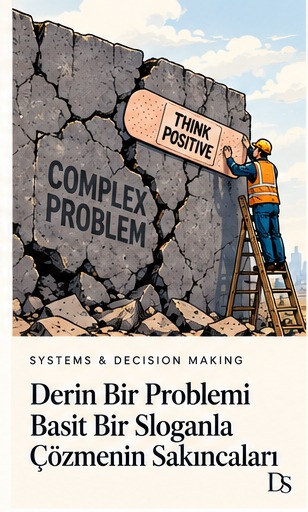
Derin Bir Problemi Basit Bir Sloganla Çözmenin Sakıncaları

Derin Bir Problemi Basit Bir Sloganla Çözmenin Sakıncaları

Günümüz dünyasında karmaşık meseleler giderek daha fazla “tek cümlelik çözümlerle” anlatılıyor.

“İnanırsan olur.”

“Zihnini değiştir, hayatın değişsin.”

“Pozitif düşün, her şey yoluna girer.”

Bu cümleler kulağa güçlü geliyor. Hatta kısa vadede motive de ediyor.

Ama asıl soru şu:

Gerçekten işe yarıyorlar mı?

Problemin Doğası: Karmaşıklık

İnsan davranışı, tek bir değişkene indirgenemez.

Davranış; düşünce, duygu, alışkanlık, çevre ve tekrarın birleşimiyle oluşur.

Sorun derinse, çözüm de katmanlı olmak zorundadır.

Tek cümlelik çözümler, bu katmanları görünmez kılar.

Slogan Ne Yapar?

Sloganlar bir şeyi iyi yapar:

Basitleştirir.

Ama aynı anda bir şeyi de eksiltir:

Gerçeği.

  • nedenleri görmez.
  • süreci atlar.
  • sistemi yok sayar.

Ve en kritik hatayı yapar:

Sonucu, tek bir faktöre bağlar.

Sakınca 1: Yanlış Nedensellik

“Başaramıyorsan yeterince inanmıyorsun.”

Bu yaklaşım, karmaşık bir sonucu tek bir sebebe indirger.

Oysa gerçek hayatta sonuç; strateji, tekrar, çevre ve zamanlama gibi birçok değişkenin birleşimidir.

Sonuç: Kişi problemi yanlış yerde arar.

Sakınca 2: Gizli Suçluluk Üretir

Sloganlar çoğu zaman görünmez bir mesaj taşır:

“Olmuyorsa, sorun sensin.”

Bu da şu döngüyü üretir:

  • Denedi → olmadı.
  • Kendini sorguladı.
  • Daha çok zorladı.
  • Yine olmadı.
  • İçsel baskı arttı.

Bu, motivasyon değil… yük üretir.

Sakınca 3: Sistemi Görmezden Gelir

Gerçek değişim rastgele değil, sistematik ilerler.

  • Davranış tekrar ister.
  • Tekrar yapı ister.
  • Yapı sürdürülebilirlik ister.

Slogan ise şunu söyler:

“Şimdi karar ver, değiş.”

Ama gerçek şudur:

Karar başlatır, sistem sürdürür.

Sakınca 4: Kısa Vadeli Etki – Uzun Vadeli Tükenme

Sloganlar üzerinden ateşlenen eylemler, sürdürülebilir davranış kalıpları üretemez.

Çünkü o eylemi besleyen yakıt sınırlıdır… ve bir süre sonra tükenir.

Bu noktada sistem, fark edilmeden bir açmaza girer:

Bireylerin birbirine katkı sunduğu bir yapıdan,

birbirinden beklenti üreten bir yapıya dönüşür.

Katkı azaldıkça beklenti artar,

beklenti arttıkça hayal kırıklığı büyür.

Kritik Kırılma: Düşünce mi, Eylem mi?

Kişinin kendisini hangi düşünce yapısıyla eyleme entegre ettiği, sürecin başında bir yargı konusu olmamalıdır.

Çünkü değişim, her bireyde farklı ilerler.

Her deneyim, farklı bir iç açılım üretir.

Aynı hedefe giden yol, herkes için aynı değildir.

Bu yüzden sürecin başında düşünceyi standardize etmeye çalışmak, çoğu zaman ilerlemeyi yavaşlatır.

Eğer amaç gerçekten iş üretmekse,

odak düşünceleri hizalamak değil…

eylem süreçlerini yönetmek olmalıdır.

Çünkü düşünce zamanla eylemi takip eder.

Ama eylem yoksa, düşünce kendi içinde dönmeye devam eder.

Daha Dürüst Bir Yaklaşım

Gerçek ilerleme, sloganlarla değil, sistemlerle olur.

Bu yüzden sistemi motive eden slogan vari düşünce yapıları yerine,

tekrar eden, ölçülebilen ve sürdürülebilen eylem döngüleri kurgulamak gerekir.

İnanç önemlidir.

Ama tek başına yeterli değildir.

İnanç başlatır.
Sistem ilerletir.
Tekrar kalıcı hale getirir.

Sonuç

Sloganlar kötü değildir.

Ama tek başına kullanıldığında eksiktir.

Derin bir problemi çözmek istiyorsak,

yüzeydeki cümlelere değil…

alttaki mekanizmalara bakmalıyız.

Çünkü gerçek değişim:

bir anda karar vererek değil,

doğru yapıyı kurarak başlar.

Son Bir Not

Birey olarak katkımız, tek başına değil,

iş birlikteliği içinde anlam kazanır.

İş birliği önemlidir.

Adil davranılması önemlidir.

Başarının temelinde çoğu zaman üç şey vardır:

umut, adalet ve aidiyet.

Ve burada kritik bir ayrım vardır:

Bunların öznesi kişiler değil…

eylemler, davranışlar ve doğru kurgulanmış sistemlerdir.

Perspectives

The Risks of Solving a Deep Problem with a Simple Slogan

Today, complex issues are increasingly explained through “one-line solutions.”

“If you believe, you can make it happen.”

“Change your mindset, change your life.”

“Think positively and everything will work out.”

These statements sound powerful. They can even be motivating in the short term.

But the real question is:

Do they actually work?

The Nature of the Problem: Complexity

Human behaviour cannot be reduced to a single variable.

Behaviour emerges from a combination of thought, emotion, habit, environment and repetition.

If the problem is deep, the solution has to be layered as well.

One-line solutions make those layers invisible.

What Does a Slogan Do?

Slogans do one thing well:

They simplify.

But at the same time, they remove something:

Reality.

  • They overlook causes.
  • They skip the process.
  • They ignore the system.

And they make the most critical mistake:

They attribute the outcome to a single factor.

Risk 1: False Causality

“If you are not succeeding, you do not believe enough.”

This approach reduces a complex outcome to a single cause.

In real life, however, outcomes are produced by the interaction of many variables, including strategy, repetition, environment and timing.

The result: the person looks for the problem in the wrong place.

Risk 2: It Creates Hidden Guilt

Slogans often carry an invisible message:

“If it is not working, the problem is you.”

This creates the following cycle:

  • Tried → it did not work.
  • Questioned themselves.
  • Pushed harder.
  • It still did not work.
  • Internal pressure increased.

This does not create motivation… it creates a burden.

Risk 3: It Ignores the System

Real change does not progress randomly; it progresses systematically.

  • Behaviour requires repetition.
  • Repetition requires structure.
  • Structure requires sustainability.

A slogan says:

“Decide now. Change.”

But the reality is:

A decision starts the process; a system sustains it.

Risk 4: Short-Term Impact – Long-Term Exhaustion

Actions triggered by slogans cannot, on their own, produce sustainable behavioural patterns.

Because the fuel driving that action is limited… and eventually runs out.

At that point, the system quietly enters a dead end:

It shifts from a structure in which individuals contribute to one another,

to one in which they generate expectations of one another.

As contribution decreases, expectations rise,

and as expectations rise, disappointment grows.

The Critical Turning Point: Thought or Action?

The mindset through which a person engages in action should not become a matter of judgement at the beginning of the process.

Because change unfolds differently for every individual.

Every experience produces a different internal opening.

The path toward the same objective is not the same for everyone.

Trying to standardize thought at the beginning of the process therefore often slows progress.

If the real objective is to produce work,

the focus should not be on aligning thoughts…

but on managing the processes of action.

Because thought can follow action over time.

But without action, thought continues to circle within itself.

A More Honest Approach

Real progress happens through systems, not slogans.

Instead of relying on slogan-like mindsets to motivate the system,

we need to design cycles of action that can be repeated, measured and sustained.

Belief matters.

But it is not enough on its own.

Belief starts.
The system moves it forward.
Repetition makes it lasting.

Conclusion

Slogans are not inherently bad.

But when used on their own, they are incomplete.

If we want to solve a deep problem,

we need to look beyond the sentences on the surface…

and examine the mechanisms underneath.

Because real change begins

not with a decision made in a single moment,

but by building the right structure.

One Final Note

Our contribution as individuals gains meaning not in isolation,

but through working together.

Collaboration matters.

Fairness matters.

At the foundation of success, there are often three things:

hope, fairness and belonging.

And there is a critical distinction here:

The subject of these is not individuals…

but actions, behaviours and well-designed systems.